
The first few weeks of university of 2022 passed relatively quickly, even though the classes took place online due to the rising covid cases. Having not been birding for a while apart from some short walks around Maastricht, I felt like it really was time to get out again. I decided to make use of the season and visit the coastal area of the Netherlands. I decided to visit the Oostvaardersplassen and Ijmuiden, two locations close to Amsterdam. A major reason to do this as to connect the trip with seeing Rashmi, a close friend from school in Sri Lanka who studies in Amsterdam. We went out birding together in Sri Lanka and so we were very happy to be able to do the same in the Netherlands. As she was quite busy with her studies, we arranged that I’d go birding on the 29th in the Oostvaardersplassen, come to Amsterdam and stay at her place, and then we visit Ijmuiden the next morning. It turned out to be a very enjoyable weekend and I had some excellent sightings, including multiple lifers.
I left the house in Maastricht early in the morning and arrived at the station right on time to catch the 8AM train. During the train ride I unsuccessfully tried to positively identify some geese in some distant flocks. Wintering flocks of geese are one of the highlights of birding in the Netherlands in winter, and since I have only once been birding at this season, I was hoping to get some lifers, like Greater White-fronted or Tundra Bean Goose. I arrived in Lelystad, the town closest to the eastern edge of the Oostvaardersplassen, at around 11 and cycled towards the wetland. I brought my bicycle along for this trip to be able to cover more ground. However, the wind was so strong that I was only inching forward, reminding me of cycling over the coastal flats on the last day of my cycling tour in Sri Lanka. Eventually I arrived at the Knardijk, a large dyke running northwards towards the Markermeer, a large freshwater lake. From the dyke, huge reedbeds dotted with trees and bushes are seen to the West. While this habitat seemed ideal for the adorable Bearded Reedling, one of my main targets of the weekend, I immediately gave up any attempts to find this bird as the wind made hearing any birds impossible, and passerines probably retreated down to the base of the reeds or into bushes.
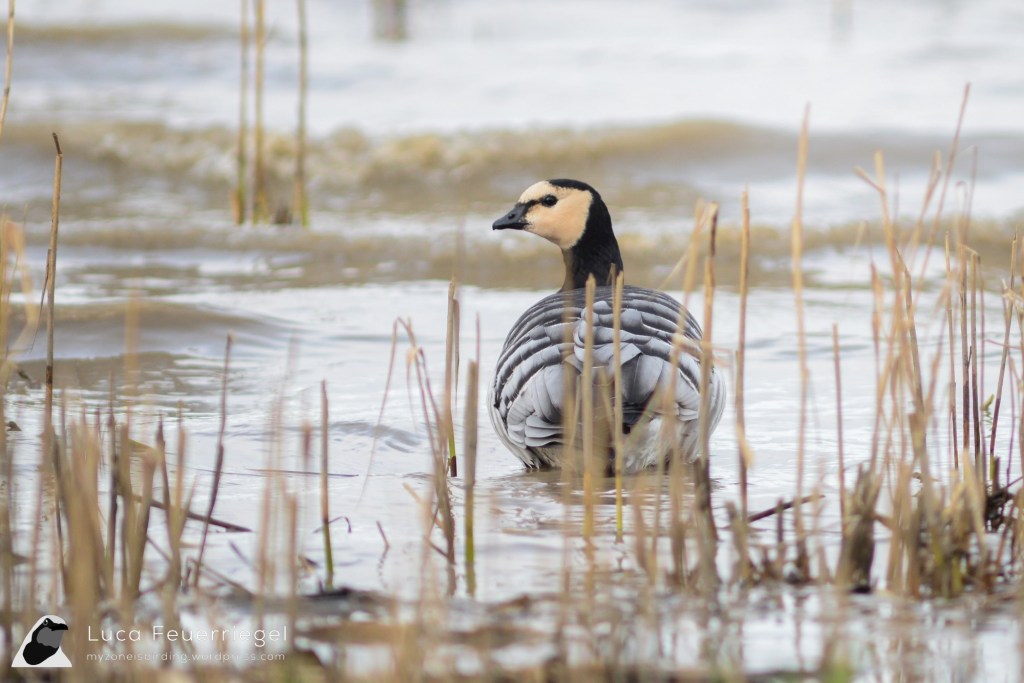
I ate some sandwiches and continued South along the dyke and stopped at the visitors center where I locked my bike and walked along the trails a bit, spending most time at the Keersluisplas hide. I was greeted by a single Barnacle Goose that found some protection from the wind in front of the hide. After a while, I was busy watching a female Common Pochard when for a fraction of a second, a black and white bird appeared on the edge of my binoculars’ field of vision – unmistakably a Smew. However, before I could focus on it, it had disappeared. The Smew is a bird I’ve wanted to see for years, so I naturally was very excited as I hoped for it to reappear for a proper view. Since I only got a brief glimpse, combined with the party I was at until just a few hours earlier, however, this excitement rapidly turned into unsettling uncertainty as I thought that my mind was playing tricks on me. Fortunately, after a few minutes, this fear was allayed as the male Smew reappeared in all its glory. I obtained some excellent views of this elegant bird, and a while later, another male arrived with two females, accompanied by several more pretty Common Pochards.
From here, I continued along the Knardijk and turned left onto the Praamweg. This road had the best birding overall, and I should have spent more time here, but the wind and made me pass through the area quite quickly. However, I did get lucky with two raptor lifers, a Hen Harrier and a White-tailed Eagle, the latter of which was unfortunately very distant. Other birds included Greenfinch, European Goldfinch, Fieldfare, and White Wagtail, while some common ducks and other frequent birds were also around.
From the Kleine Potgieter, I was hoping to be able to identify some geese on the open flats, but the strong wind made using the scope and even binoculars impossible. This was frustrating, but there were quite a few birds present, including Mute Swan, Garganey, Mallard, Northern Shoveler, and surprisingly large numbers of Great White Egret.
Reaching the Grote Potgieter without further interesting sightings, I returned along a cycling track alongside a canal, ending at the end of the Knaardijk. Here, I saw Great Crested Grebe, Common Goosander and masses of Tufted Ducks. From the Knardijk I turned back to Ijmuiden, this time along the Torenvalkweg, which proved to be a good choice as I had two sightings of Hawfinch, a special of the Oostvaardersplassen, and a beautiful Northern Goshawk flying low over a ploughed field.
I arrived at the train station quite relieved to be out of the wind. I was satisfied with the birds I saw but the wind had really drained me. The Oostvaardersplassen is definitely a place I want to return to for birding, as a lot more species are possible. On the train ride to Amsterdam, I finally got a positive ID of a few Greater White-fronted Geese. I arrived at the residency building of the Amsterdam University College and was really happy to be greeted by Rashmi. After we had dinner and I got to know her flatmates, we went to a nearby bar and had a very enjoyable time remembering some shared experiences back in Sri Lanka and talking about our time in the Netherlands and in general the last year during which we did not see each other. Exhausted after little sleep and a long day, plus having to wake up early the next morning, I called it a day as soon as we got back home.
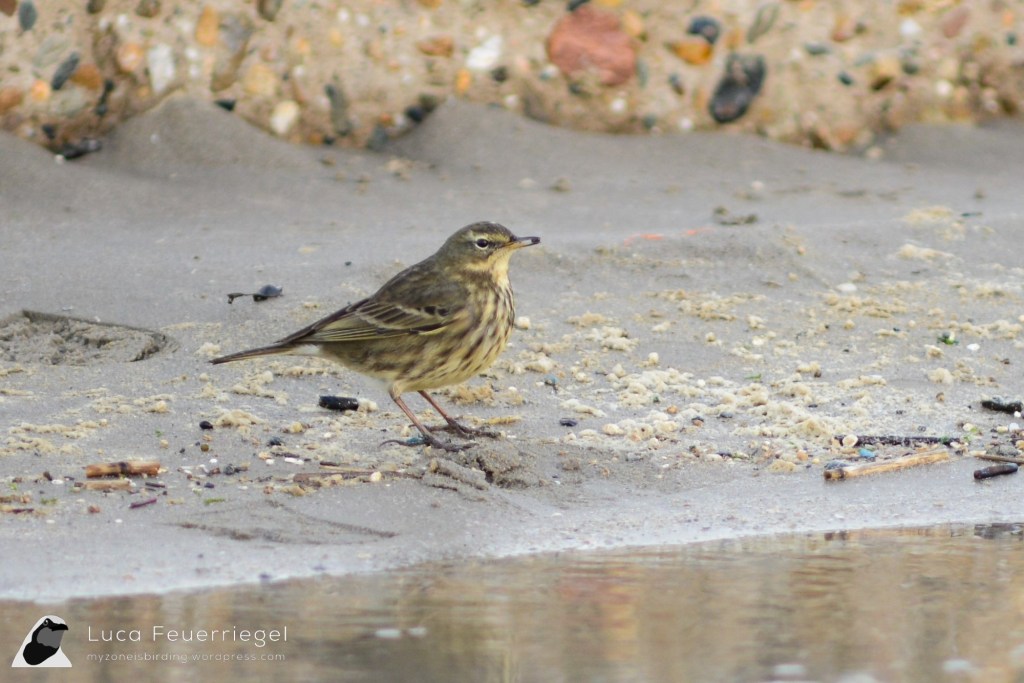
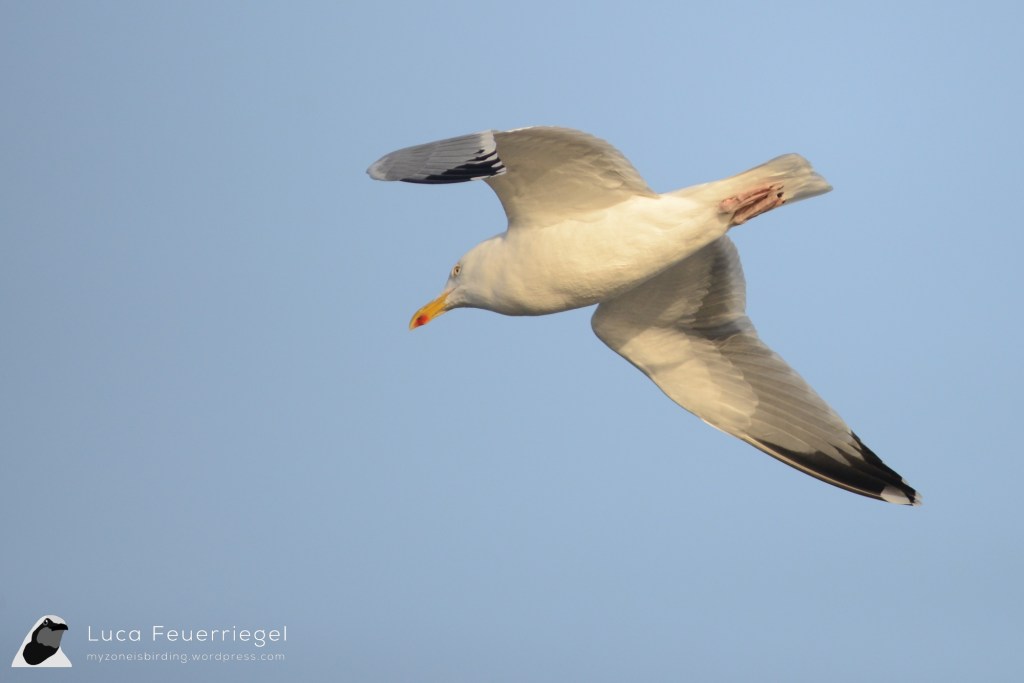
We took the trains to get to Schiphol, and from there a bus to Ijmuiden, stopping at the last bus station right at the harbor. Alighting from the bus, we were greeted by extremely strong and cold wind that had us both shivering so much that before even getting to the pier, we started to doubt whether this outing had been a good idea. The harbor held Great Crested and Little Grebes, Eurasian Coot, and Great Cormorant while many Black-headed, Common, and Herring Gulls were flying overhead and a group of House Sparrows took shelter by the buildings. At the start of the pier, we noticed that the pier itself was closed because of the wind, and a local resident told us that it was very unusual that the wind comes from the North, usually it comes from the south west. Given that the pier is the main highlight at this spot, this was quite a disappointing start. We were compensated by a close-up Rock Pipit however, which ended up being very common along the start of the pier.
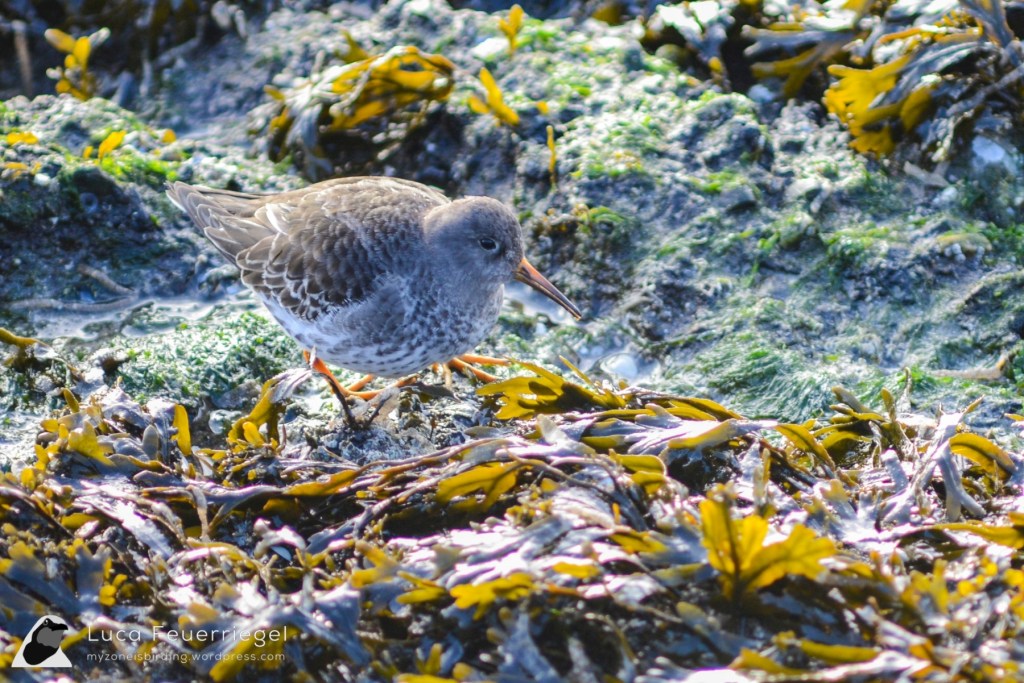
Just as other birders already present on the scene, we did the only sensible thing and took cover on the beach just to the south, where the pier blocked the worst of the wind, and scanned through a group of gulls on the beach. This was good ID practice for me, as I have very little experience identifying gulls. While I was hoping for a less common species, it turned out that there were four common species in the flock: Black-headed, Herring, Great Black-backed, and Lesser Black-backed Gulls, but no rarer species. Eurasian Oystercatchers, foraging and resting among the gulls, were a nice addition. Overhead, Great Cormorants constantly passed, but we were on the lookout for European Shag. After one or two uncertain birds, a Great Cormorant passed overhead with what was in direct comparison definitely a European Shag. On the rocks forming the base of the pier, a large number of Ruddy Turnstones was roosting together with two Sanderlings. The wind abated a bit so we walked along the pier up to the gate that barred further access, some 50m from the shore. Three tame Purple Sandpipers allowed a close approach as they foraged on the sheltered side of the pier – another lifer and target of the day. After some time, we located three Common Scoters were floating on the rough waters quite a distance away. The storm made it hard to keep the scope stable as I only have a monopod, but after a while we both got adequate views.
Given that the weather was improving and the wind abating, it was very unfortunate that the pier was not opened, as walking out to the tip would have been very enjoyable and would have given us a shot at a few specials we both wanted to see, such as Guillemot, Northern Gannet and divers. However, we decided to move away from the sea a bit and retreat to the dunes. The Kennemermeer lake harbored a nice surprise when, among a group of gulls, Shelducks, Mallards and Tufted Duck, a stunning male Common Goldeneye surfaced. We had brief but repeated views between of this bird which I had really wanted to see. From here we crossed the dunes for another brief look at the beach. Just as we arrived, a group of small passerines flew low over the beach. The flight appeared very bunting like, and sure enough, they turned out to be Snow Buntings! Two individuals were in their stunning pied plumage – an unexpected lifer for both of us, and another bird I had wanted to see for ages. Elated, we continued along the path around the Kennemermeer. The coastal scrub held few species, but Feral Pigeon, House Sparrow, Dunnock, Blue and Great Tits, and Common Chafffinch were around.
We returned to the bus stop and soon were on our way back to Amsterdam. We wanted to get a piece of apple pie from the cafe Winkel 43, but this unfortunately turned out less enjoyable than expected as the place was full, and when the take-away pieces of pie we then ordered eventually arrived, they were already cold. However, it was still very tasty, especially after a day out in the cold. When we got back to Rashmi’s residence, I hurried to pack up my bags and just made it on the train back to Maastricht, where I arrived in the evening. It was great to be able to go out birding properly – I noticed when updating my birding journal that I hadn’t been on a weekend dedicated to birding for several months. I was also happy to see two new outdoor locations and a bit more of Amsterdam. Living in the Netherlands but not knowing the country well is a real pity, so I’m always glad to get to know more of the area. Of course, seeing Rashmi again after so long was a highlight of the weekend. Rashmi returned to Ijmuiden a few weeks later on a tour guided by Arjan Dwarshuis and got lucky with a Kittiwake and Iceland Gull, a clear sign that this was also not my last time visiting this location!
 My Zone Is Birding
I much enjoyed your report, which gives me renewed interest for expeditions in England when I return there later this year.
LikeLike
Thanks!
I’m actually also going to England for my university semester abroad in autumn/ winter, very much looking forward to the birds there (and the studying of course ;).
LikeLike